Earlier today I came across a guide from Every on building AI style guides, and the premise was deceptively simple: if you want AI to write like you, you have to teach it how you actually think, not just what to say.
I’d been using AI to write content for a while by that point, and while the results were solid, whenever I tried to write anything personal, something always felt slightly off. It’s like someone had ironed all the creases out of my voice.
So I decided to build it properly.
The process started with an interview rather than a blank document. Instead of trying to describe my style from scratch, which tends to produce flattering generalities rather than anything actionable, I answered questions one at a time.
- What feeling did I want to leave readers with?
- What made a good opening?
- What made me cringe when I read something back?
The answers that came out surprised me. I knew I wanted readers to feel intrigued and inspired, but articulating that I also wanted them to actually do something after reading gave the whole thing a direction it hadn’t had before.
What also helped was that we weren’t starting from nothing. Years of writing, dozens of drafts, and feedback from people around me had already created a record of what worked, what didn’t, and why. The patterns were already there. Pulling them together made them visible in a way they had never been before.
The test drafts caught things I hadn’t anticipated. A piece would come back and include an em dash despite it being in the blacklist, because the draft had created a rhythm problem and reached for the easiest fix. A paragraph would stack short fragments for dramatic effect and end up sounding more like AI than the original prompt. Each of those moments added something specific to the skill, not just “avoid this” but why it fails and what to do instead.
What I learned through all of this is that it took multiple tries, reading multiple guides, and learning to recognise which advice was there to create hype rather than to be genuinely helpful, before I started getting output that actually felt like me
The quality of what comes back is almost always a reflection of the specificity of what you put in, and vague instructions about voice produce generic writing, every time.
The result is a Claude Skill, which is a reusable file that loads into Claude and governs how it writes whenever I want something in my personal voice.
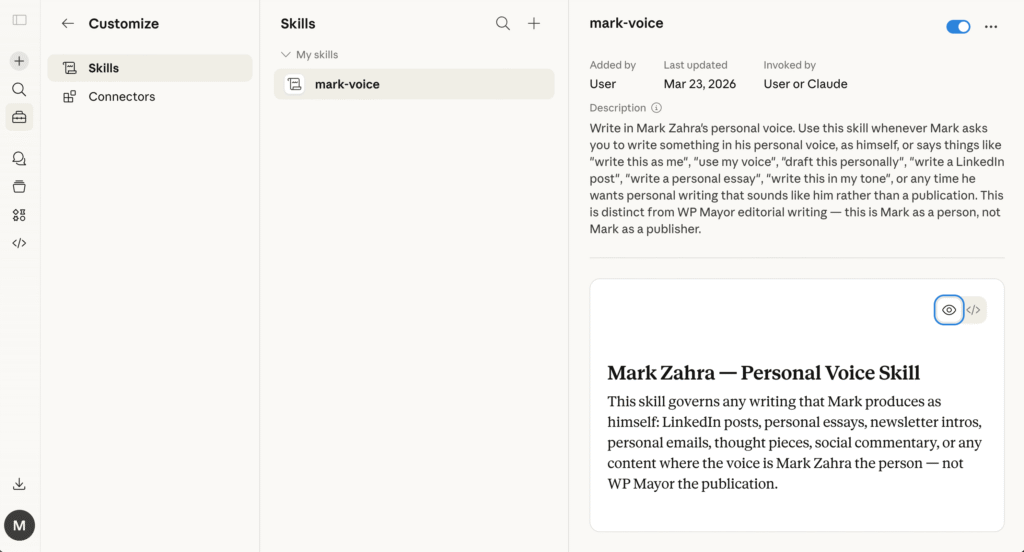
It’s not finished, and it won’t be for a while. It gets better every time I use it, catch something that misses the mark, and add that back into the record. That’s the actual point of building it this way rather than writing it once and moving on.
If you’ve been using AI for personal writing and the results keep feeling slightly off, the Every guide is worth a genuine hour of your time.
Do the interview rather than trying to randomly describe your voice, react to real examples instead of generalities, and build your own skill from what you learn.
It’s a slower start, but it’s the only approach that has actually produced something that sounds like me.
Leave a Reply